09 July 2012

Socialist-Revolutionaries, Narodniks, and other Adventurists

0 comments

Course on Anti-Imperialism, War and Peace, Part 3b


Socialist-Revolutionaries, Narodniks, and other Adventurists

Our pattern is as follows: There are ten parts, one part per week. In each part there may be up to four items. The main post is given first. The others can be used as alternatives, if preferred, or as additional reading. The whole arrangement is designed to suit study circles who would meet once a week to discuss these texts.

In this part we have gone in reverse chronological order. The third and last item (attached) in this part is from the earlier, pre-revolutionary period, where Lenin is denouncing the “Revolutionary Adventurism” of the “Socialist Revolutionaries”, and in particular is denouncing terrorism.

Like Marx and Engels before him, and like the SACP of today, Lenin was faced with false revolutionaries, who pretended to be more revolutionary than the communists, but who were really something else.

The communists are referred to in this pamphlet as “revolutionary Social-Democrats”.

In this Russian case the false revolutionaries were the petty-bourgeois “Socialist-Revolutionaries” (SRs) and their antecedents, the sentimental “Narodniks”. Both of these types of pseudo-revolutionary are likely to spring up in any revolutionary situation. In general, they represent the strong desire of the ruling class to reappear in a new guise, to steal the very revolution that they have provoked, and therefore to continue their rule in a new form. This is especially the case in a transition, like Russia’s at the time, from a monarchy to a republic.

The terrorist SRs called themselves “critics” and they called their revolutionary opponents (i.e. Lenin and the RSDLP) “orthodox”. This is like the liberals and anarchists of today in South Africa who denounce the SACP as “Stalinists” or “vanguardists”, or even as “yellow communists”, while imagining themselves to be free-thinkers.

This document was written in a typical situation, similar to Swaziland today, where there is a dying monarchical autocracy and a large but very poor peasantry, all festering in the dregs of feudalism. There is a dangerous “absence of ideology and principles”. Among other important things, Lenin writes:

“Let the agrarian programme of the Socialist-Revolutionaries serve as a lesson and a warning to all socialists, a glaring example of what results from an absence of ideology and principles, which some unthinking people call freedom from dogma.

“When it came to action, the Socialist-Revolutionaries did not reveal even a single of the three conditions essential for the elaboration of a consistent socialist programme: a clear idea of the ultimate aim; a correct understanding of the path leading to that aim; an accurate conception of the true state of affairs at the given moment or of the immediate tasks of that moment.

“They simply obscured the ultimate aim of socialism by confusing socialisation of the land with bourgeois nationalisation and by confusing the primitive peasant idea about small-scale equalitarian land tenure with the doctrine of modern socialism on the conversion of all means of production into public property and the organisation of socialist production.

“Their conception of the path leading to socialism is peerlessly characterised by their substitution of the development of co-operatives for the class struggle.”


06 July 2012

Guerrilla Warfare

0 comments
Course on Anti-Imperialism, War and Peace, Part 3a


Guerrilla Warfare

Just after the first Russian Revolution of January, 1905, Lenin wrote “Guerrilla Warfare” (download linked below). Almost immediately in this work, Lenin plants his experienced revolutionary feet on solid revolutionary ground, thus:

“Marxism differs from all primitive forms of socialism by not binding the movement to any one particular form of struggle.

“It recognizes the most varied forms of struggle; and it does not "concoct" them, but only generalizes, organizes, gives conscious expression to those forms of struggle of the revolutionary classes which arise of themselves in the course of the movement.

“Absolutely hostile to all abstract formulas and to all doctrinaire recipes, Marxism demands an attentive attitude to the mass struggle in progress, which, as the movement develops, as the class consciousness of the masses grows, as economic and political crisis become acute, continually gives rise to new and more varied methods of defense and attack.

“Marxism, therefore, positively does not reject any form of struggle. Under no circumstances does Marxism confine itself to the forms of struggle possible and in existence at the given moment only, recognizing as it does that new forms of struggle, unknown to the participants of the given period, inevitably arise as the given social situation changes. In this respect Marxism learns, if we may so express it, from mass practice, and makes no claim whatever to teach the masses forms of struggle invented by ‘systematisers’ in the seclusion of their studies.”

Later in the same work, in which he defends the Latvian comrades who have taken up some forms of armed struggle, Lenin says:

“… such an objection would be a purely bourgeois-liberal and not a Marxist objection, because a Marxist cannot regard Civil War, or guerrilla warfare, which is one of its forms, as abnormal and demoralizing in general.

“A Marxist bases himself on the class struggle, and not social peace. In certain periods of acute economic and political crisis the class struggle ripens into a direct Civil War, i.e., into an armed struggle between two sections of the people. In such periods a Marxist is obliged to take the stand of Civil War. Any moral condemnation of Civil War would be absolutely impermissible from the standpoint of Marxism.”

Are you worrying about what form your struggle should take? Read this document, comrades.


05 July 2012

Uprising

0 comments

Course on Anti-Imperialism, War and Peace, Part 3


Uprising

“To be successful, insurrection must rely not upon conspiracy and not upon a party, but upon the advanced class. That is the first point. Insurrection must rely upon a revolutionary upsurge of the people. That is the second point. Insurrection must rely upon that turning-point in the history of the growing revolution when the activity of the advanced ranks of the people is at its height, and when the vacillations in the ranks of the enemy and in the ranks of the weak, half-hearted and irresolute friends of the revolution are strongest. That is the third point. And these three conditions for raising the question of insurrection distinguish Marxism from Blanquism.”

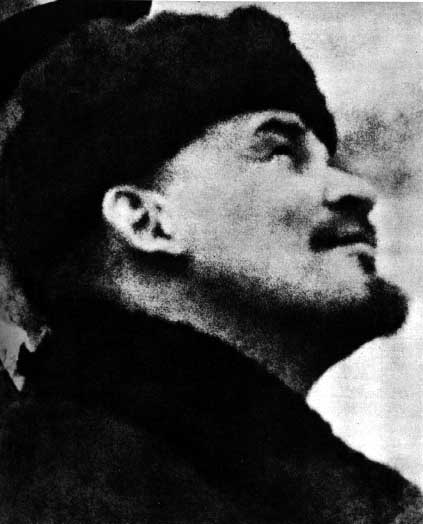
Thus wrote Lenin [Image], in “Marxism & Insurrection” (download linked below), in September 1917, just before the Great October Russian Revolution.

Insurrection must rely upon the advanced class, and not upon the party. It must rely on an uprising of the people, and be timed to coincide with their maximum degree of resolution and the maximum degree of vacillation in the ranks of their enemies.

Lenin concludes:

In order to treat insurrection in a Marxist way, i.e., as an art, we must at the same time, without losing a single moment, organise a headquarters of the insurgent detachments, distribute our forces, move the reliable regiments to the most important points, surround the Alexandriusky Theatre, occupy the Peter and Paul Fortress, arrest the General Staff and the government, and move against the officer cadets and the Savage Division those detachments which would rather die than allow the enemy to approach the strategic points of the city. We must mobilise the armed workers and call them to fight the last desperate fight, occupy the telegraph and the telephone exchange at once, move our insurrection headquarters to the central telephone exchange and connect it by telephone with all the factories, all the regiments, all the points of armed fighting, etc.

“Of course, this is all by way of example, only to illustrate the fact that at the present moment it is impossible to remain loyal to Marxism, to remain loyal to the revolution unless insurrection is treated as an art.”

Insurrection is an art! This is a short document, comrades, and readable. Read it.


02 July 2012

Genesis of the NDR

0 comments

Course on Anti-Imperialism, War and Peace, Part 2b


Genesis of the NDR

The Hammer and Sickle emblem of the communists was invented in Russia in 1917. It is a symbol of class alliance between two distinct classes: proletarian workers, and peasants.

Peasants often work hard and they are often poor, but they are not the same as the working proletariat of the towns. Nor are they the same as the rural proletariat. So the hammer and the sickle are not two identical things. They represent two different things, allied.

Practical politics is always a matter of alliance, and in different circumstances, different alliances are called for. Communists commonly regard an alliance between workers and peasants as normal. Proletarian parties have likewise, in the past, often attempted class alliances with (other) parts of the bourgeoisie against feudalism, or against colonialism.

Alliances are normal and necessary, in order to isolate and thereby to defeat an adversary, and equally, to avoid being isolated and defeated by that adversary. Therefore, the question of the appropriate alliances in the anti-colonial and anti-Imperialist struggle was bound to arise.

The origin of the specific type of class alliance that is nowadays referred to by the term National Democratic Revolution can be precisely located in the Second Congress of the Communist International (2CCI), in the discussion in the Commission on the National and Colonial Question, reported to the plenary by V. I. Lenin on 26 July 1920 (attached).

The first, founding Congress of the Communist International (“Comintern”) had taken place in March, 1919, a little over a year after the October 1917 Russian Revolution. It fulfilled the tenth of Lenin’s “April Theses”: “We must take the initiative in creating a revolutionary International”.

The very first “International Working Men’s Association”, of which Karl Marx had been a founder member in 1864, had been disbanded in 1871 after the fall of the Paris Commune.

The Second International fell apart in 1914, when most of the Social-Democratic workers’ parties backed the bourgeois masters of war in the conflict between the Imperialist powers.

The communists, led by Lenin, had held out against that betrayal. After the revolutionary victory in Russia they lost very little time before constructing a Third, Communist International. It was naturally and explicitly anti-Imperial and anti-colonial and decisevely so at its Second Congress (the “2CCI”) in 1920.

In his report to the 2CCI on the National and Colonial Question, Lenin says: “We have discussed whether it would be right or wrong, in principle and in theory, to state that the Communist International and the Communist parties must support the bourgeois-democratic movement in backward countries. As a result of our discussion, we have arrived at the unanimous decision to speak of the national-revolutionary movement rather than of the ‘bourgeois-democratic’ movement. It is beyond doubt that any national movement can only be a bourgeois-democratic movement, since the overwhelming mass of the population in the backward countries consist of peasants who represent bourgeois-capitalist relationships… However, the objections have been raised that, if we speak of the bourgeois-democratic movement, we shall be obliterating all distinctions between the reformist and the revolutionary movements. Yet that distinction has been very clearly revealed of late in the backward and colonial countries…”

Here we find, for the first time, all the makings of the NDR, including the name, even if the words are not quite in their present-day order. Lenin calls it “national-revolutionary”, but he makes it very clear that he is talking of a democratic class alliance with anti-colonial, anti-Imperialist elements of the national bourgeoisie in colonial countries.

The 2CCI was followed within two months by the famous “Congress of the Peoples of the East”, in Baku, in the southern part of what was soon to become the Soviet Union. This was the first international anti-colonial conference. It had huge consequences. The remainder of the 20th century was marked by world-wide National Democratic Revolutions according to the pattern set by Lenin and his international comrades.

These National Democratic Revolutions included, and still include, the South African NDR.


29 June 2012

Consequences of Imperialist War

0 comments

Course on Anti-Imperialism, War and Peace, Part 2a

Lenin in disguise, 1917

Consequences of Imperialist War

The origin of the Age of Imperialism, when it became dominant in the world, were the Imperial wars at the turn of the 19th to the 20th centuries, and most typically the Anglo-Boer War.

The Anglo-Boer War is the most typical of the original, because it showed most clearly what the nature of the new capitalist Imperialism was. Britain made war on the Boer Republics, not so as to rule them directly, and certainly not to liberate the black people living under those racist regimes, but only to possess the gold mines and other such assets as they might wish to have.

The recent Imperialist war on Libya is not different in overall nature.

The typical tactic of Imperialism is not direct colonialism, but indirect, neo-colonialism. As the 20th century went on, the obligations that went with direct rule were abandoned. As a counter to the National Democratic Revolutions, neo-colonialism was increasingly substituted for the older system of direct colonial rule.

This much was described by Lenin in the text that went with the previous post in this series. Lenin paid close attention to the question of Imperialism and wrote a lot about it during this time. It may be helpful for us to look briefly at the general situation before 1916, and thereafter.

The Great Powers had gone to war in 1914, as a consequence of the tensions that Imperialism had brought with it, in a finite, limited world that had been divided between them, but unevenly.

The Workers’ (Second) International had, instead of opposing the war, collapsed. The socialist parties of the contending powers had nearly all opted to support their different bourgeois governments in the terrible mutual slaughter and destruction.

Lenin and the Bolsheviks refused to support the war. They formed the major force in the small “Zimmerwald” International, together with other formations that wanted to maintain the international working-class position of opposition to capitalist war.

By that time Lenin had been in exile for many years. He returned from Switzerland to Russia in April, 1917, a few weeks after the February revolution of that year.

In “The Nascent Trend of Imperialist Economism” (attached), Lenin attacks the “Imperialist Economism” that is against the right to self-determination and against democracy.

Imperialist Economism has “the knack of persistently ‘sliding’ from recognition of imperialism to apology for imperialism (just as the Economists of blessed memory slid from recognition of capitalism to apology for capitalism),” says Lenin.

“Economism” is Syndicalism, or in South African parlance, “Workerism”. It is the belief that trade union struggles alone can solve the problems of the working class. It is reformist, and it relies upon the promises of development of the capitalist economy, with no plans to overthrow it.

“Imperialist Economism” took the reformist logic one step further, to say that Imperialism should be allowed to develop to its fullest, in the belief that when the whole world had become one big monopoly, it could simply be taken over and re-named socialism. The Imperialist Economists promoted the idea that socialism was the end-destination of the Imperialist bus-ride, and that all that was necessary was to get on the bus and encourage Imperialism’s progress, in the name of socialism.

The German Social-Democrat Karl Kautsky, who Lenin called a “renegade”, and “no better than a common liberal”, became the prophet of Imperialist Economism.

In the face of this particular brand of treacherous liquidationism, Lenin was obliged to re-state the necessity for the right of nations to self-determination (see the second attached item). This is a longer document. In it, early on, under the heading “Socialism and the Self-Determination of Nations”, Lenin wrote: “We have affirmed that it would be a betrayal of socialism to refuse to implement the self-determination of nations under socialism.”

So as not to make this introduction to long, let us sum up:
  • There is no final separation between socialism and internationalism (“Workers of the World, Unite!”) but
  • Nations have the right of self-determination

Using the next item we will see the consequence of this struggle of ideas, as it affected the world after the Russian Revolution, and after the Imperialist world war of 1914 -1918 was over.  We will see that Lenin personally, and the Communist International in particular, were able to map out the line of march for the National Democratic Revolutions that subsequently liberated most of the planet, including, eventually, South Africa, from direct colonialism.


28 June 2012

Imperialism

0 comments

Course on Anti-Imperialism, War and Peace, Part 2

Lord Kitchener poster, 1914

Imperialism

This is the second part of a series on Anti-Imperialism, War and Peace. We are not only concerned to discover Imperialism, but to see it in its particular aspect of war-mongering. [Image: Lord Kitchener, master of war and lying face of Imperialism]

In Chapter 7 of “Imperialism, The Highest Stage of Capitalism” (attached) Lenin “sums up” in a highly compressed way as to what capitalist imperialism is. In the first paragraph, among other things, he says:

“…the monopolies, which have grown out of free competition, do not eliminate the latter, but exist above it and alongside it, and thereby give rise to a number of very acute, intense antagonisms, frictions and conflicts.”

A little later on Lenin writes: “… politically, imperialism is, in general, a striving towards violence and reaction.” The truth of this statement has never been more apparent than it is today.

South Africa has seen Imperialism in all its aspects, but especially in war. It was the Anglo-Boer War of 1899-1902 that announced Imperialism’s intentions to the world, as much as the Spanish-American War of 1898 did, or the defeat of the Khalifa Abdallahi's forces at Omdurman in Sudan by the British under Kitchener in that same year of 1898. The system of state-monopoly capital and dominance of the mineral-energy complex over the South African productive economy dates from that time, and it has never been fundamentally changed. To change it will mean a new confrontation with Imperialism.

Imperialism is a system of war. Lenin pours scorn on “Kautsky's silly little fable about "peaceful" ultra-imperialism,” calling it “the reactionary attempt of a frightened philistine to hide from stern reality.”

Lenin concludes:

“The question is: what means other than war could there be under capitalism to overcome the disparity between the development of productive forces and the accumulation of capital on the one side, and the division of colonies and spheres of influence for finance capital on the other?”

The age of Imperialism, for more than 110 years, has been an age of war, just as Lenin predicted it would be. From Lenin’s work to that of William Blum’s “Killing Hope” it is clear that Imperialism is an aggressive force which at some stage will have to be confronted. One cannot hope to be exempt from this confrontation forever.


  • A PDF file of the reading text is attached


25 June 2012

The First International

0 comments

Course on Anti-Imperialism, War and Peace, Part 1b

Revolution in Paris, France: February 1848

The First International

The Communist Manifesto is a deliberately internationalist document. Karl Marx and Frederick Engels were deployed to write it by the international Communist League, of which they were members. The League was strongly based among continental workers in London, where the first edition was printed (in German) while Marx was running a part of it in Brussels, Belgium. Engels was in Germany, and Communist League members were in action in many other countries including France.

The Manifesto’s publication coincided almost exactly with the outbreak of revolution in France, in February of 1848, which quickly spread to other countries. The final Chapter IV of the Manifesto says among other things that: “… the Communists everywhere support every revolutionary movement against the existing social and political order of things,” and it finishes with the famous slogan “Working Men of All Countries, Unite!”

The Communist Manifesto is one of the first two books of Marxism to come into the public realm. Both were written and published in 1847/early 1848 (the other book is “The Poverty of Philosophy”).

Marxism was internationalist from the start and it has never ceased to be so.

Most of the revolutions of 1848 were aimed at overthrowing feudal monarchies, or in other words turning kingdoms into republics, if necessary by supporting the bourgeoisie in the anti-monarchy revolution. The content of Marxist internationalism to this day includes relentless opposition to monarchy.

Marx’s 1864 Address to the International Working Men’s Association (The First International) was the consequence of his being invited and elected to the leadership of that organisation formed in London in a hall next to where the South African High Commission now stands. Please download and read the Address in the downloadable document linked below. Marx had been in exile in London since 26 August 1849 after being banished in quick succession from Belgium, Germany and France. In 1864, Marx’s reputation was that of being the foremost internationalist of his time.

The First International survived until the fall of the Paris Commune in 1871. The Second International was established at a gathering in Chur, Switzerland ten years later in 1881, two years before Marx’s death in 1883 and fourteen years before Engels’ death in 1895. The Second International fostered Lenin and Rosa Luxemburg among many others. Its collapse in 1914 marked the great division between the opportunists (such as the “renegade” Kautsky) who in the face of imperialist war folded their internationalism and became cowardly national chauvinists, and on the other hand the true internationalists like Luxemburg and Lenin who opposed the imperialist war. These latter ones, the true internationalists, were also the communists, who established the communist parties of today.

The Third International, also called the Communist International (or Comintern) was launched in Soviet Russia less than two years after the October Revolution, in 1919, and in 1921 it admitted the Communist Party of South Africa into membership, thus founding the party that is today known as the South African Communist Party, the SACP.

The history of the communists is an unbroken line of internationalism of which the SACP is an indissoluble part. The SACP is still internationalist and it continues to promote the same relentless anti-monarchical, anti-feudal, anti-colonial, anti-neo-colonial, anti-imperialist cause as before and will do so until the day of continental permanent proletarian revolution dawns in Africa.


23 June 2012

1850 Address to the Communist League

0 comments
Course on Anti-Imperialism, War and Peace, Week 1a

1848 in Berlin

1850 Address to the Communist League

When history is on the move the changes run all over the place. The job of the communists is invariably to urge history on, and to push all the players, including the bourgeoisie, to play their parts to the utmost extent.

The phrase "permanent revolution" belongs first to Marx and not to Trotsky. It comes from the March, 1850 Address given by Karl Marx to the Central Committee of the Communist League, of which "permanent revolution" are the last two words. See below for a link to a downloadable file of this great document.

"Permanent revolution" only means a qualitative change that will be defended.

It does not mean that the revolution is irreversible.

Nor does it mean that the revolution has to be repeated constantly like the punishment of Sisyphus.

The March, 1850 Address to the Communist League is an internationalist document. At the time, the newly formed communist organisations were active all over Europe, in a time when monarchies were falling and feudalism was on the way out in many countries.

Read the document with care and attention!


22 June 2012

On War

0 comments

Anti-Imperialism, War and Peace, Part 1


 On War

Michael Howard, translator of Clausewitz’ work, and author of “Clausewitz”, opens his Introduction with a quote from one Bernard Brodie, about Clausewitz: “His is not simply the greatest, but the only great book about war;” and Howard records his own agreement with this assessment.

If you can get it, Howard’s book helps readers a lot towards understand Clausewitz’ “On War” (Chapter 1, the summarising chapter, is attached) but in one respect Howard appears to be mistaken.

After describing Clausewitz’ “dialectic” (e.g. the relationship between physical and moral forces; between historical knowledge and critical judgement; between idea and manifestation; between “absolute” and “real” war; between attack and defence; and between ends and means) Howard writes: “The dialectic was not Hegelian: it led to no synthesis which itself conjured up its antithesis. Rather it was a continuous interaction between two poles, each fully comprehensible only in terms of the other.”

But it would seem to be perfectly Hegelian to conceive of such a unity and struggle of opposites; and as to whether Clausewitz’s dialectic lacked a forward dynamic, or not, is something that can be settled at once by reading only a few pages. Whereupon it will be found that Clausewitz is surely one of the most dynamic authors ever.

Clausewitz was ten years younger than Hegel, but died only two days after Hegel, on 16 November 1831. They were both victims of the same cholera epidemic.

Since Hegel’s was the official philosophy of Prussia, and Clausewitz was in charge of the Prussian War College in Berlin for twelve years, while Hegel was Professor of Philosophy at the University of Berlin, it is impossible to believe that Clausewitz was not familiar with Hegel’s then highly fashionable ideas.

These were the same Hegelian ideas that seized the imagination of Karl Marx and Frederick Engels (both of whom spent time in Berlin during the late 1830s to early 1840s) and upon which their thinking relied for the rest of their lives. Clausewitz and Marxism are not far apart, neither in their pedigree, nor in the philosophical structure of their thinking.

Much is made, in the commentaries on Antonio Gramsci’s 20th-century writings, of the contrast between wars of manoeuvre and of position. But the military breakthrough of Clausewitz’s lifetime was the French revolutionary campaign against its neighbours, including Prussia, which had rendered obsolete, already in the 1790s, the ancient military alternatives of march and siege which were the limits of Gramsci's military perception, still, in the 1930s.

Although a servant of the Prussian crown, what Clausewitz described was warfare in the age of mass democracy. As one who fought against Napoleon, Clausewitz had understood Napoleon’s warfare as well as, or better than, anyone else.

Clausewitz defined strategy and tactics as “the linking together of separate battle engagements into a single whole, for the final object of the war.” To define strategy in this way, as end, and tactics as means, was a profound contribution for which we in South Africa owe a debt to Clausewitz.

Equally as profound is the complex of thinking around Clausewitz’ well-known understanding of war as an extension of politics, by other means.

Not only does this mean that war is always and everywhere subordinate to politics; but it also means that war (the breakdown of negotiation and the resort to force) must, and can only, return the parties to the negotiating table. War is an interlude of brutality between negotiations. This was Clausewitz’s most famous insight.

To sum up: The world of 1848, when the Communist Manifesto was first published, was already charged up with historical potential by great preceding events, first and foremost among them the Great French Revolution, with the Napoleonic Wars that followed it; and also by great thinkers and writers, foremost among them GWF Hegel and Carl von Clausewitz, whose insights will assist us to understand the place of violence in the history of revolution.


21 June 2012

Short General Introduction

0 comments

Anti-Imperialism, War and Peace, Part 0


Short General Introduction

To Anti-Imperialism, War and Peace


We are about to begin a new course on the SADTU Political Education channel: Anti-Imperialism, War and Peace. A previous edition of this course can be accessed here.

The series begins with Chapter 1 of Clausewitz’ “On War”, described by one critic (Bernard Brodie) as “Not simply the greatest, but the only great book on war”. Clausewitz shows the dialectical (or in Clausewitz’ term “reciprocal”) nature of any study of war. It also shows that war can only be an interval between negotiations. It is the pursuit of politics by other means, means which cannot be conclusive, but which have to yield in due course to politics, again.

We are for peace but we have to be prepared for war. We are not pacifists, though we have no interest in bloodshed. We seek the ascendancy of the working proletariat. We know that the bourgeois power is everywhere defended with brutal force.

The ANC democratic breakthrough owes its existence to successful armed struggle, in turn a part of a historic worldwide struggle against Imperialism. Yet the South African armed struggle is barely acknowledged. Instead, bourgeois virtues are daily paraded in front of us by bourgeois “role models”. The South African police shoot demonstrators, while bourgeois pacifism is pushed as a compulsory ideology for the rest of us.

Internationally in the 21st Century, Imperialism has embarked upon a series of wars, including wars in Africa, which have the character of “underdeveloping” once again and subordinating, or recolonising, African countries.

Therefore it is necessary to have a frank look at the question of the military. The political democracy must know enough about war to be able to oversee and to command the military. The military must always be subordinate to the political. This is the most important thing to know.

20 June 2012

SA Working Class and the NDR

0 comments

Basics, Part 10c


SA Working Class and the NDR

In this final part of our “Basics” course, we have looked at democracy, armed struggle, and popular unity-in-action, in terms of various countries of the world. Now we look again at South Africa. The National Democratic Revolution is not a South African invention. It is a worldwide phenomenon, but it has also generated a specifically South African literature of the NDR.

Joe Slovo published the SA Working Class and the National Democratic Revolution (see the link below) at a time when he was the General Secretary of the SACP. The Party was still clandestine. The end of its 40-year period of illegality was to come two years later. Like many political documents, this pamphlet takes shape around a polemical response to contemporary opponents who may no longer be well-remembered (in this case it was the particular “workerists” and compromisers of the time that Slovo mentions on the first page of the document).

But as with the polemics of Marx, Engels and Lenin, in the course of the argument against otherwise long-forgotten foes, Slovo was obliged to set up a fully concrete, rounded assessment of the meaning of the NDR, which still remains today as the best single and definitive text on this matter in South Africa.

Slovo quickly establishes the class-alliance basis of the NDR and quotes Lenin saying that: “the advanced class ... should fight with… energy and enthusiasm for the cause of the whole people, at the head of the whole people”. This advanced class is the working class. Slovo goes on to write of the continuity of the NDR and of the institutional organisation that is the bricks-and-mortar of nation-building.

Slovo’s is a long document but it has many possibilities as the basis for a discussion and that is always our purpose: dialogue.

This instalment ends the “Basics” course.


  • The above is to introduce the original reading-text: The South African Working Class and the NDR, 1988, Slovo, Part 1, Part 2 and Part 3.


19 June 2012

The Armed People

0 comments

Basics, Part 10b


The Armed People

A practical, actually-existing alternative to the bourgeois State – The Commune – arose in Paris, France, in the beginning of 1871.

It was more than the “right of recall”, and it was more than the whole people collectively in power and in perpetual democratic session. It was also the reappearance of The Armed People in a new kind of societal framework.

So-called Primitive Communism is an Armed People. Primitive Communism has been destroyed, and continues to be destroyed, by the simultaneous rise of property relations and fall of the women. But here, in the Paris Commune, was an Armed People in advanced productive circumstances. The Paris Commune prefigured the end of the bourgeois State’s monopoly of violence, and the consequent eventual fall of the bourgeois State in the world as a whole.

The security forces (army and police) existing in France prior to the Paris Commune had been paid by the bourgeois State to guarantee its survival. They were tasked with suppressing the working class, whenever they found suppression to be necessary, by any means of suppression they thought necessary, and they were therefore constantly prepared for bloodshed and slaughter. These forces were disbanded by the Commune and were not replaced until the Commune fell.

With hardly any exceptions, all “separations of powers” were abolished in the Paris Commune, leaving one main and constant power: The Armed People.

A century later in Chile, in the time of the Popular Unity government that fell on 11 September 1973, instead of an Armed People, a virtue was made of disarmament, and a “Peaceful Path” was worshipped as the new political Golden Calf.

In the document linked below, Volodia Teitelboim gives a brief description, from the point of view of one of those who was involved in the Chilean Popular Unity government, of its disastrous end. The fascists used the national army to overthrow the national government on behalf of the bourgeoisie. It was a shocking reminder of the real purpose and nature of the “special bodies of armed men” that are part of The State. They are there to preserve the allegiance of the State to the bourgeoisie.

Teitelboim calls for “A Reappraisal of the Issue of the Army,” meaning a return to the view of the Paris Commune, which is mentioned in the first line of Teitelboim’s document. This document is sufficient as the basis for a very good and necessary discussion in South Africa at this time.

Like the Chilean Popular Unity government, ours in South Africa today is a multiclass government underpinned by a class alliance for common goals. It is a unity-in-action, otherwise called a Popular Front.

Why has the South African NDR survived for 17 years, while the Chilean Popular Unity fell after 1,000 days?

The answer could be that we are not pacifists, as so many of the Chilean Popular Unity politicians were.

Or, the answer could be that our crisis has just not arrived yet.

Or, that we have passed at least one crisis, which may not yet be the last. That was in mid-2008, and it was resolved by the recall of President Mbeki and the resignation of various ministers including Terror Lekota and Mluleki George, Minister and Deputy Minister of Defence, respectively.

Picture: There are very few images of freedom fighters in formation, in action, or ready for action, to be found on the Internet, whether of MK or of any other liberation army. But there are many photographs of freedom fighters in captivity, or dead.

Full justice has not yet been done. Alive or dead, the revolutionaries are still rebels and outcasts in the minds of the “respectable” bourgeoisie, who owned the cameras, then, and who own the photo-archives, now.

For our part, we are still singing the Internationale, composed in Paris in the days of the Commune by the communard Eugène Pottier.

The picture is of a statue of the freedom fighter Dedan Kimathi, under the blue sky of Kenya.

AMANDLA!