12 June 2010

Eighteen-Forty-Eight

0 comments
 
Paris, February 1848

Eighteen-Forty-Eight

Lenin spends the first five of the six existing chapters of “The State and Revolution” tracing the development of the thought of Karl Marx and Frederick Engels. In Chapter 2, (download linked below) he sweeps through the period of bourgeois revolutions in mid-nineteenth-century Europe that started in 1848. [The picture above represents Paris in February, 1848]

Marx and Engels had good timing. Engels had witnessed Manchester in the early 1840s in the full bloom of its emergence as the first great industrial city of the world. He had also, with Marx, engaged in literary disputes with the Young Hegelians in Berlin and elsewhere in Germany, and other disputes with the anarchists of the time. They had also corresponded with the Chartists. They had spent time organising in Paris and in Brussels.

Berlin, March 1848

Then they found themselves on the crest of the extraordinary revolutionary wave of 1848, and so they were well-positioned to record it and to learn its lessons, just as they were with later episodes, notably the Paris Commune of 1871.

In the first line of Chapter 2 Lenin describes “The Poverty of Philosophy” (together with the Communist Manifesto), written in 1847 when Marx was still in his twenties, as “the first mature works of Marxism.” The book was written as a polemic against one (Pierre-Joseph Proudhon) of several anarchists that Marx had to contend with. These anarchists tested and tempered Marx’s and Engels’ resolve, in hard debate.

Lenin moves on to the Communist Manifesto, where he immediately derives the term “dictatorship of the proletariat” from the equally direct words of the Marx and Engels in the Manifesto, namely: “the state, i.e. the proletariat organised as the ruling class”.

“The state is a special organization of force: it is an organization of violence for the suppression of some class.”

The proletariat will use the state to suppress the bourgeois class.

Chartist rally, Kennington, London, 1848

Lenin then turns on the reformists. Later, in Chapter 3 of "State and Revolution", Lenin calls the anarchists and the petty-bourgeois opportunists “twin brothers”.

Here in Chapter 2 he writes:

“The petty-bourgeois democrats, those sham socialists who replaced the class struggle by dreams of class harmony, even pictured the socialist transformation in a dreamy fashion — not as the overthrow of the rule of the exploiting class, but as the peaceful submission of the minority to the majority which has become aware of its aims. This petty-bourgeois utopia, which is inseparable from the idea of the state being above classes, led in practice to the betrayal of the interests of the working classes.”

The chapter proceeds to touch “The Eighteenth Brumaire of Louis Bonaparte”. It returns to Marx on the dictatorship of the proletariat, this time in those very terms, in a letter written in 1852; and Lenin says: “Only he is a Marxist who extends the recognition of the class struggle to the recognition of the dictatorship of the proletariat.”

Download:


08 June 2010

Class Society and the State

0 comments
 

Class Society and the State

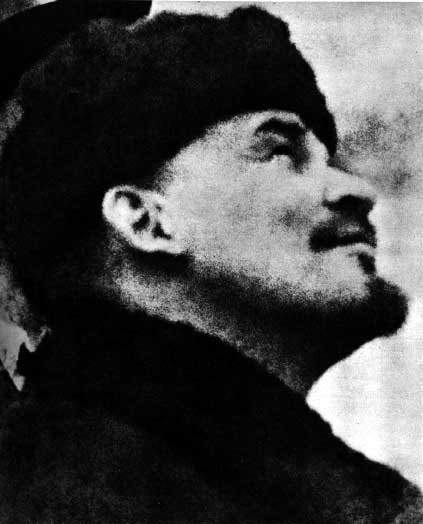
V I Lenin wrote "The State and Revolution" between the February 1917 bourgeois-democratic revolution in Russia, and the October 1917 proletarian revolution. The latter dramatically interrupted his writing, leaving the work unfinished. [Picture: Lenin in 1917]

SACP Deputy General Secretary Jeremy Cronin has remarked that South Africa is in some ways stuck “between February and October”, meaning to compare our SA situation during the 16 years since 1994 with the eight months in 1917 between the two Russian revolutions.

It therefore seems worthwhile to run all six chapters of “The State and Revolution” as a course, set or series of the Communist University, now. In length, they are well suited to the purpose. It is even possible that this kind of treatment, and this way of collective study, was exactly what Lenin had in mind when he wrote the work. He referred to it as a “pamphlet”, which would tend to mean a text for mass agitational propaganda.

The urgency of Lenin’s revolutionary purpose is apparent from the first paragraph (of Chapter 1, download linked below), as is the priority he gives to the understanding of The State as a product of, and integral to, the exploitative class-divided social system that the Bolsheviks were determined to overthrow, and therefore a matter of the highest revolutionary importance.

Hence the first words are a definition and a challenge to those who would think otherwise: “The State: a Product of the Irreconcilability of Class Antagonisms”

In the first paragraph Lenin refers to the embracing of “Marxism” by the respectable bourgeoisie, and their pleasure at the amenability of “the labour unions which are so splendidly organized for the purpose of waging a predatory war!”

The great war that was raging at the time was not merely an incidental background to the Russian Revolutions of 1917. Like the lethal global neo-liberalism of recent times, the “First World War” (the Imperialist War) had seduced the major part of the social-democratic organisations that claimed to represent the working class. The structures of the working class had turned against the working class, and the crux of the matter was the question, then as now, of The State. Lenin is unequivocal:

“The state is a product and a manifestation of the irreconcilability of class antagonisms. The state arises where, when and insofar as class antagonism objectively cannot be reconciled. And, conversely, the existence of the state proves that the class antagonisms are irreconcilable.”

Lenin proceeds to write that the overthrow of the bourgeois state has to be direct and forcible, whereas the withering-away of the proletarian state can only be the indirect consequence of the progressive disappearance of class antagonism during the transitional period called socialism.

"The State and Revolution" goes to the very heart of the revolutionary theory of class struggle, sharpens all contradictions, and draws clear lessons - lessons that are still relevant today, and especially for South Africa.


YCL World Cup graphics

0 comments

07 June 2010

Lenin’s The State and Revolution

0 comments

Lenin’s The State and Revolution

Short General Introduction


The State and Revolution is a book of Lenin’s that was written in the months in between the February and October Russian Revolutions of 1917.

Interrupted by the Bolshevik Revolution, it was never completed.

The State and Revolution is an uncompromising description of The State and of how it can be revolutionised, written as a rehearsal and critique of the writings of Marx and Engels on the one hand, and those of various reformist, opportunist and anarchist characters on the other hand, finishing with Kautsky.

Kautsky had been the principle renegade at the outbreak of the war that was still going on in 1917, and which did not come to an end until the following year.

The State and Revolution is well worth studying in its entirety of six chapters. In form, it is ideal for the Freirean method of pedagogy through study circles. Each Chapter is of a suitable length for reading and discussion by a group that meets weekly.

The question that Lenin puts unavoidably in front of us is that of the State.

The problem that appears is: whether or to what extent the State can be treated as benign, or developmental? In the SACP we do not repudiate Lenin, yet we still praise state ownership and state “delivery”. How are these things reconciled? If the State is benign, then why would we want it to wither away? If the state is but a committee for managing the common affairs of the whole bourgeoisie [Marx/Engels, Communist Manifesto], and “an Instrument for the Exploitation of the Oppressed Class” [Lenin, State & Revolution] then how can it at the same time be beneficial?

Lenin realised that the eventual transition to communism had to be secured in the process of the transition to socialism. He realised that there would be a moment of danger when it would be possible that the worker’s state could redevelop the characteristics of the bourgeois state.

This is what happened in the Soviet Union under Stalin, and the eventual consequence was the collapse and break-up of the Soviet Union into a scattering of bourgeois states. The revolution was not permanent, after all. The undead bourgeois state re-grew itself like a “Terminator”.

The next post will open the discussion of Chapter 1 of The State and Revolution. From then to the end of this series, the chapters will be sent out as weekly parts in a series, together with links to downloadable files of the original texts, in the tried-and-tested manner suitable for the holding of weekly political education study circles.

06 June 2010

Three new courses

0 comments
Message to SADTU Political Education Forum, Communist University, and CU Africa


Three new courses


Dear Comrades,

The weekly course previously running on the SADTU Political Education Forum about the National Democratic Revolution has already come to an end. It will be replaced by a course with six main parts, on Lenin’s “The State and Revolution”.

The weekly course that has been running on the Communist University distribution - "No Woman, No Revolution" - will come to an end this week. It will be replaced by a ten-part course called “Philosophy and Religion”.

At the same time, a course with 24 main parts on Karl Marx’s “Capital, Volume 1” will commence on the new, African-continental “CU Africa” forum. It will be followed on that forum by a further ten main parts covering Capital, Volumes 2 and 3. This is intended as a major initiative aimed at reclaiming Marx’s great work “Capital”, making it widely familiar and giving it popular currency once again.

The purpose of this message is to alert you to the existence of all three courses, and to make all of them accessible to you, no matter which of these three groups you may presently belong to.

Blogs and E-mail Groups

Each of the three channels consists of a “blog”, which is a web site, and an e-mail Group which sends the blog-posts by e-mail to a list of subscribed addresses. The three different blogs are as follows:

SADTU Political Education Forum: http://sadtu-pol-ed.blogspot.com/
Communist University:                  http://domza.blogspot.com/
CU Africa:                                    http://cuafrica.blogspot.com/

All of these blogs have instructions, in the right-hand panel, for subscribing to the associated e-mail forum or distribution group, so that you may directly receive what appears on the blog in your email “Inbox”.

Archive

An archive will be kept in the form of a list of linked list of documents and downloads, maintained on a separate web page for each course. Each archive will be a page on the relevant blog.

Table

All of the above information will be displayed, in the week following the posting, in a small table giving updated links to the previous instalments. This table is designed to be included with every e-mail post, so as to help you to keep up with all three of these courses, should you wish to do so.

The table will look something like this (test the links if you wish):

Previous week’s main political education posts

Date/Post
Number
Home
Archive
(Sunday) starting 6 June
x/6
(Tuesday) starting 8 June
x/12
(Thursday) starting 17 June
x/36

Subscription

You are welcome to subscribe to any or all of the three e-mail groups. If you have any difficulty using the subscription boxes on the blogs, please send a message to dominic.tweedie@gmail.com, naming the group you wish to subscribe to.

If you subscribe to these e-mail groups, you will receive the blog posts automatically as e-mail. In the case of the SADTU and CU Africa groups, they are fora, meaning that the subscribers may also post, and so contribute to the creation of a collective discussion between members.

Hard Copy

In South Africa, the materials used in these courses is available from the Jetline Company. To avail yourself of this service, please go to any of the blog sites given above, and follow the Jetline instructions given in the panel on the right-hand side.


Hoping that these new arrangements will find favour,

I remain your

“VC”.

01 June 2010

ANC Strategy and Tactics, Polokwane

1 comments
CU, NDR, Part 12a
  
ANC Strategy and Tactics, Polokwane

This is the last item of the CU series on the National Democratic Revolution which has been running via the SADTU Political education blog, and the SADTU Political Education e-mail forum. It has also been running on the Ars Notoria web site. It will be followed in these particular channels, from next week, by a six-part series on Lenin’s “The State and Revolution”

Also starting very soon, but via other, different channels, will be a ten-part CU course on Philosophy and Religion and a twenty-four part CU course on Karl Marx’s Capital, Volume 1. If you wish to make sure of receiving these other two distributions, in addition to “The State and Revolution”, please send your e-mail address to dominic.tweedie@gmail.com, with an indication of which additional courses you wish to receive.

Static or revolutionary?

This, the second in this final part, where the main document is the SACP 2009 discussion document, is the current version of the ANC Strategy and Tactics, amended several times since the original was adopted in Morogoro in 1969, as passed by the 52ndANC National Conference at Polokwane,

The ANC 52nd National Conference was otherwise considered a victory for the popular forces within the ANC. But from paragraph 90, this document launched a revision of the previously much clearer understanding of class and colour in South Africa.

Now, in the latest S and T, all are ranked in a single notional table, as “motive forces”. “Blacks in general and Africans in particular” become commensurate with “The Working Class”.

In the draft, monopoly capital, too, was going to be included as a “motive force”, thereby removing even the oppressor from the equation, but this was changed in commission at Polokwane.

This version of the S&T document remains above all marred by its static and non-revolutionary conception of “National Democratic Society” as a “Holy Grail” and final steady-state condition of what Thabo Mbeki used to call a “normal” society.

The idea of closure on the NDR without its becoming something more, is close to Francis Fukuyama’s provocative 1992 “post-Cold-War” essay “The End of History and the Last Man”. History has not ended; and the “Last Man” is only a nightmare of the proto-fascist philosopher Friedrich Nietzsche (1844-1900).

We have not arrived at a closure of the NDR. The struggle continues.Hi

[Image: ANC President Jacob Zuma]

Downloads:


Further reading:


28 May 2010

Ward and Voting District demarcation

0 comments

ANC Today, 28 May 2010


Ward and Voting District demarcation


Why are we getting new wards and changing some of the existing wards?

The Municipal Structures Act says that wards must have more or less the same number of voters. No more than 10% deviation from the average is allowed. New wards are added before every local election and the boundaries of existing wards often change.

The Municipal Demarcations Board (MDB) is in charge of determining the boundaries of municipalities, and of wards within municipalities. The number of councillors in each municipality is determined by the number of voters and the Member of the Executive Council (MEC) for Local Government applies the legal formula and publishes the number of councillors in the Government Gazette. Half the councillors have to come from wards (and the other half from the Proportional Representation list). If there has been a significant increase in the number of voters in a municipality, more wards will be added.

What is the process?

It is not a simple process to add more wards, because of the requirement that wards must have more or less the same number of voters. As new wards are created the boundaries of existing wards also sometimes have to change to ensure that all wards have similar numbers of voters.

The MDB proposes changes to municipalities and publishes them for comment. This process usually starts about two years before an election. If there are no objections, local council stakeholder meetings sign off on the changes and they are implemented. If there are objections from any party, or a dispute about where boundaries should be, the MDB visits the affected area and holds a meeting with all parties to the dispute. They attempt to get agreement and sign-off on new boundaries from all the parties involved. If that fails, the MDB can make the decision.

A Schedule 1 notice is then published about the new boundaries and a two-week formal objection period is allowed before the boundaries are finalised.

Where is the process now?

By the end of May all stakeholder meetings should be completed.

64% of notices have already been published and the rest should be published in June.

The MDB will convene Ward Delimitation Committees in June and July 2010 to decide on the merit of objections received after which it will finalise the wards for the 2011.

As the ANC we should avoid unnecessary delays to the finalisation of wards. Objections should only be made in very serious cases. The timeframes are very tight and any further delays will compromise the opportunities for voter registration.

The MDB has to provide to the IEC the final set of wards on 1 Sept 2010.

What does the Independent Electoral Commission (IEC) do?

The IEC then matches the ward boundaries to Voting District boundaries. Most of the 19 000 VDs will remain intact, but a few thousand will change because they are cut in two by new ward boundaries. A number of new VDs are also created in new urban settlements or in rural areas where previous boundaries were impractical.

The IEC proposes new VD boundaries to local Party Liaison Committees who have to sign off on the maps before they can be finalised. Voter registration or re-registration of voters whose VD changed, can only start once maps are printed.

The IEC will then conduct targeted registration in changed VDs, upload the data and update the voters roll.

Two public voter registration weekends are usually held. After the first one the roll is again updated and the new version is open for checking at the second weekend. The voters roll closes as soon as elections are proclaimed - usually about 2-3 months before the election.


Hegemony in the NDR

0 comments
CU, NDR, Part 12

Hegemony in the NDR

On 14 September 2009 the South African Communist Party released a main discussion document (click on the link below) in preparation for the SACP Special National Congress that took place in December 2009 at the Turfloop campus in Polokwane, Limpopo Province.

This document is titled “Building working class hegemony on the terrain of a national democratic struggle”. It is therefore directly in line with the previous eleven parts of this series on the National Democratic Revolution, and presents an opportunity to conclude the 12-part series in an open-ended fashion that is suited to the present conjuncture.

The most relevant parts of this document to our discussion so far are Part 2.4 (“The politics of working class hegemony...versus the politics of a multi-class balancing act”) and the whole of Part 3 (“Towards a politics of mass-driven, state-led radical transformation on the terrain of a National Democratic Revolution”).

In an echo of Lenin’s “The State and Revolution”, the SACP document notes that the “sectarian left” (equivalent to Lenin’s “anarchists”) and the “centrist reformists” (Lenin’s “opportunists”) are twins in their subjective denigration of the NDR. Lenin said that the anarchists and the opportunists are twins.

This discussion document was work-in-progress.

At the Congress, a Political Report was given which is downloadable in PDF format from the SACP web site, here. It is called “Together, let’s defeat capitalist greed and corruption! Together, build socialism now!”

As usual in the Freirean practice of pedagogy, we are not looking for closure, but rather to reveal and expose the problems of the moment: In short, to problematise

The second instalment of this part will be the Strategy and Tactics document passed at another Polokwane event, held two years earlier, the 52nd National Conference of the ANC; and that will be the end of the series on South Africa’s National Democratic Revolution this time around.

Downloads:

Further (optional) reading:


25 May 2010

The Brutal Side of Capitalist Development

0 comments
CU, NDR, Part 11b


The Brutal Side of Capitalist Development


The third document in this part of our NDR course wherein the main text is Joe Slovo’s “SA Working Class and the NDR”, is David Moore’s 2004 article, “The Brutal Side of Capitalist Development” (linked below).

The article can stand as a representation of the growing realisation in broader South African circles that the class struggle is still the engine of history, including historical “development” in any useful sense of the word, and that class struggle has winners and losers, so that the idea of “win-win” development is wholly illusory.

By 2004 the promise of a beneficial New World Order following the collapse of the Soviet Union a decade-and-a-half previously had proved false. Instead, the USA and its “coalition of the willing” had mounted monstrous, plundering, Imperial wars against Afghanistan and Iraq, which are referred to briefly in this article. There was clearly to be no holiday from class struggle at any level.

In South Africa, the YCL had been re-launched the previous year (2003) and the SACP was undergoing a growth phase which is still continuing now, in 2010.

The ANC NGC in the following year (2005) showed that the ANC, had become mature and democratic in its legal form, reborn since 1990.

COSATU’s affiliates had mostly stabilised into strong working-class negotiating machines capable of taking on any employer.

Moore’s article in the short-lived Johannesburg newspaper “ThisDay” was a groundbreaker. It reminded readers that development is class struggle. For practitioners of the National Democratic Revolution, this was a potential turning point.

It remains to be seen whether the change has been made. The 2007 Strategy and Tactics draft was arguably even more of a “balancing act” than previous documents of the ANC. This, and the 2009 discussion document for the SACP Special Nation Congress of that year, will form the last part of this 12-part series on the NDR, next week – not for “closure”, but rather to demonstrate the state of the national-democratic-revolutionary debate while the struggle continues.

Downloads:


Further reading:


24 May 2010

Transformation, Not a Balancing Act

0 comments
CU, NDR, Part 11a


Transformation, Not a Balancing Act

The main text of this part of the 12-part NDR series is still Joe Slovo’s “The SA Working Class and the NDR”. The supporting texts begin with “We Need Transformation, Not a Balancing Act” by Blade Nzimande and Jeremy Cronin (linked below), published in 1997, nine years after Slovo’s pamphlet. This was the year following the institution of what has since become known as the “1996 Class Project”, of which it is an initial critique.

In the mean time, the SACP and the ANC had been legalised in 1990, the UDF had been disbanded, the CODESA talks had taken place, SACP General Secretary Chris Hani had been assassinated, the ANC had been elected to government in 1994, and Joe Slovo had passed away (on 6 January 1995). All of this triumph and tragedy, and a lot more, historically formed the National Democratic Revolution, and not least in terms of the building of the ANC and the SACP as legal, open, organised structures around this large country with its population of approximately 40 million at the time.

This SACP document looked at a number of other documents published in those days, including from the ANC Youth League, from COSATU, and from the SACP itself, but in particular from the ANC in the form of a November, 1996 document called “The State and Social Transformation” (note that the Young Communist League was not re-established until 2003).

Nzimande and Cronin were saying that the ANC document stood out from the others in terms of its class-neutral “balancing act” approach. They conclude that the document should rather have been called “The State and Social Accommodation”.

Another way of putting this would be to say that the ANC document in question was selling class collaboration and not class alliance. “The State and Social Transformation” was selling the end of class struggle instead of the prosecution of the class struggle by alliance with favourable forces, against unfavourable forces.

There is a difficulty in Nzimande’s and Cronin’s document. On the third page, under “Dealing with capital”, two conceptions of capital are described: “factors of production” and “capital meaning capitalists”. The authors say that in the ANC document these two conceptions are elided or confused, giving the impression that factors of production can only come attached to capitalists, which is not so, they say.

That is all well and good, but what is absent is the understanding of capital as a dynamic relationship, and the “accumulation” of capital as being the reproduction of that relationship and of all of the support to that relationship, including the market, the proletariat, the bourgeoisie and the bourgeois state with its bourgeois constitution and laws, the means of transport and trade, and the subordination of all other classes to the rapacious needs of the bourgeois class.

Even in terms of pure money, what the capitalist principally does with it is to throw money into circulation, and not withhold from circulation by hoarding it. The accumulated wealth of the miser is not capital, though it may be money.

The circulation of money as capital proceeds via the purchase of labour-power and the extraction of surplus-value. Therefore, we do not escape the reproduction of capital by making the state the owner of the capital. The M-C-M' cycle is what capital is.

The revolutionary escape from capital is only achievable by accumulating the prerequisites of socialism, which mainly consist of the ever-increasing ability of masses of people to resolve and act together, consciously, and scientifically. This is the crucial “Democratic” part of the National Democratic Revolution.

Nzimande’s and Cronin’s document does arrive at this point. At the end, it does confirm that the free-willing collective Subject is both the maker and the product of revolution.

[Images: Nzimande and Cronin]

Downloads:


Further reading: